
A practical first-run route built around the current collision rules, movement effects, deck consistency, and community-tested archetype patterns.
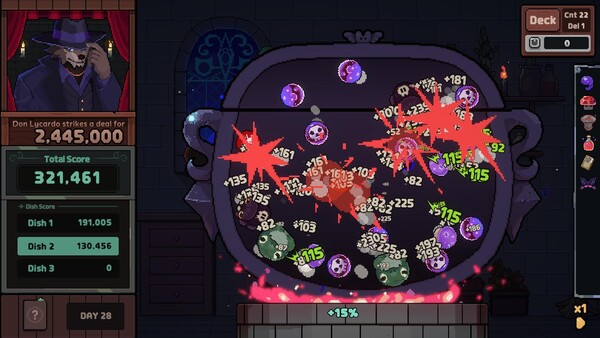
Build one trigger-to-payoff chain and protect it from deck bloat. Kinny gives each dish a limited number of drops, so the first run is not about discovering every ingredient. It is about making the same useful event happen often enough to reach the next score target.
Before the first drop
Read the active customer target and the complete text on the starting ingredients. Then assign three jobs:
- Trigger: creates movement or a state change.
- Target: receives the repeated contact or transformation.
- Payoff: adds score when that event occurs.
If the opening deck has no clear payoff yet, favor an ingredient whose effect is easy to trigger repeatedly. The current community guide describes rotation, attraction, repulsion, and explosions as the main movement tools. Rotation is especially useful for generating additional contacts, but the best choice is the one your available ingredients can actually exploit.
Use the 20-drop budget deliberately
A current player build guide records a maximum of 20 ingredient drops per dish. Use the first quarter of that budget to confirm the trigger works. Use the middle drops to repeat the highest-value contact. Keep the final drops for a missing payoff piece or for recovering a dish that is behind target.
Do not spend the last few drops introducing a new family unless its text immediately improves the current dish. A late speculative ingredient has little time to find its partner and may displace the card you already know scores.
Three current archetype patterns
These patterns come from a current Steam Community guide, not from an official balance sheet. Use them to understand roles and then read the English text in your own build before committing.
Chicken plus rotation
The community route pairs a dense chicken family with cats that create rotation when they contact chicken-type ingredients. The strength is repeated contact; the weakness is that egg generation can bloat the deck. A relic that suppresses egg production turns that downside into a more consistent draw pool. The transferable lesson is to pair a family payoff with a movement trigger and then remove the family’s source of clutter.
Salt plus destruction
The community guide describes Salt Spirit as splitting on contact and being destroyed after the follow-up interaction. Rotation helps create those contacts, while destruction-triggered relics convert the repeated cycle into score or economy. This route fails when the cauldron cannot keep the salt pieces moving, so secure the trigger before stacking destruction bonuses.
Seafood plus attraction
Attraction effects can pull fish into more contacts, but the route needs a workable balance between fish, seafood, and its movement support. Adding too many producers can make the deck too large to draw the rotational support the build needs. Stop adding producers once the trigger becomes less reliable.
Pick the next reward with one question
Ask: Does this reward make my most frequent event happen more often or score more when it happens? Take it if the answer is clear. Skip it if it introduces an unrelated family, relies on a trigger you do not own, or solves a problem the current dish does not have.
If the score stalls, diagnose only one layer:
- No movement means the trigger is missing.
- Plenty of movement but weak score means the payoff is missing.
- Both exist but rarely appear means the deck is bloated.
- The chain works but ingredients leave the useful area means cauldron control or space is the next priority.
For the current price, content scale, and broader system map, return to the Kinny and the Cosmic Cauldron guide.
Sources
QUICK ANSWERS
Questions players ask next
What should I do first in Kinny and the Cosmic Cauldron?
Pick one repeatable event—usually a collision created by rotation, attraction, repulsion, or an explosion—then take ingredients and relics that either trigger it or score from it.
How many ingredients can I drop in one dish?
A current Steam Community build guide records a 20-ingredient drop limit per dish. Treat that as current-build community evidence and recheck it after major balance patches.
Why does my Kinny build stop appearing?
The reward pool grows as more ingredients and combinations unlock. Avoid adding unrelated ingredient families; every extra card can reduce the chance of drawing the trigger or payoff your build needs.
HELP SHAPE THE NEXT UPDATE
Missing an answer—or found something outdated?
Send the exact game problem, platform, and version. Corrections are reviewed before expansion requests.